OpenCFO
Fintech / AI SaaS

Reimagining
Financial Intelligence
for Modern Businesses

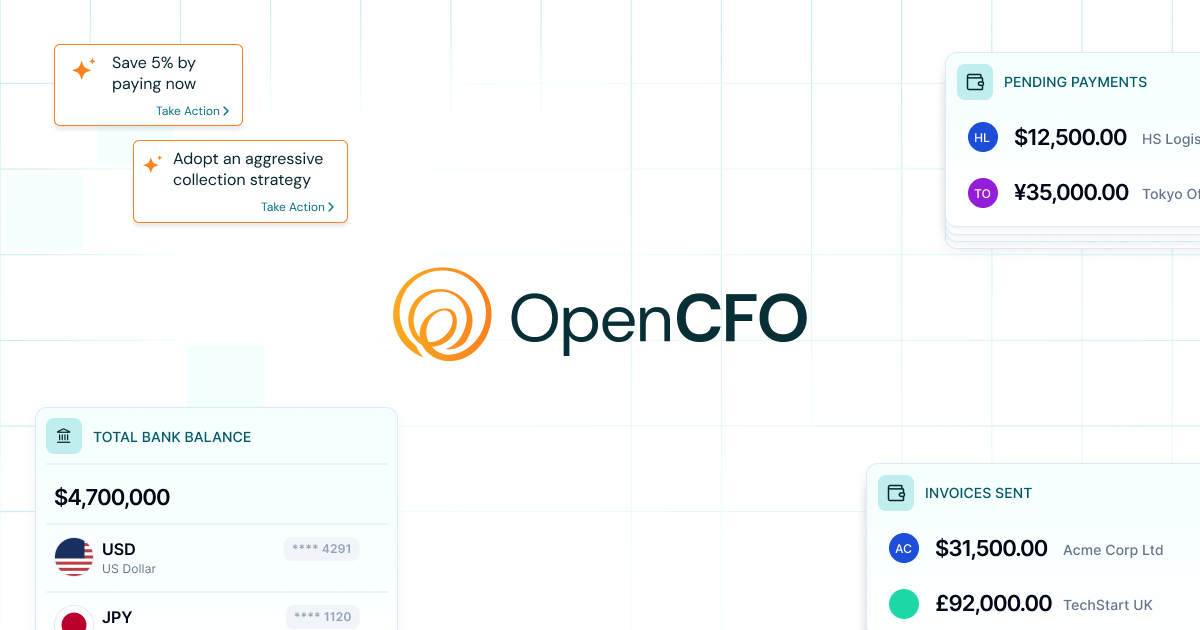
Designing OpenCFO — a real-time AI cash flow platform that transforms how finance teams see, predict, and act on money movement.
Role Product & UI/UX Designer
Timeline 2024
Category Fintech / AI SaaS
Platform Web Application
Cash Flow This Month
+$42k
Q3 Forecast AI
+28% Revenue
OpenCFO platform
0% Cash Visibility
$0 Flows Tracked
0 Onboarding
0% Forecast Accuracy

The Problem

Finance teams were
flying blind

CFOs and finance teams at SMBs were drowning in spreadsheets, disconnected bank feeds, and reactive decision-making. Cash flow — the single most critical metric for business survival — was invisible until it was too late.

The Opportunity

There was no intelligent, unified platform that gave real-time cash flow visibility with predictive insights — especially for SMBs who lacked the enterprise budgets for tools like Anaplan or Adaptive Insights.

OpenCFO's mission was clear: bring financial-grade intelligence to every CFO, regardless of company size. The design challenge was making AI-powered complexity feel effortless.

Cash Flow Intelligence AI Forecasting Financial UX SMB Finance
Research Insights
01 / 03

The Spreadsheet Trap

82% of finance teams still relied on manual spreadsheet reconciliation, causing 15+ hours per week of wasted effort — and introducing compounding errors into critical financial decisions.

02 / 03

Visibility Blindspot

CFOs couldn't see their cash position across all accounts in real-time. Most strategic decisions were being made on week-old data — a dangerous lag in volatile market conditions.

03 / 03

Adoption Barrier

Enterprise finance tools were prohibitively complex and expensive. SMB finance teams needed genuine analytical power without the steep learning curves or six-figure implementation costs.


02 — User Research

User Persona & Goals

Understanding who we design for — their motivations, goals, and pain points.

👤
Rajan Gupta
CFO, 44
  • Get real-time cash flow visibility across all accounts
  • Generate board-ready reports without analyst assistance
  • Run scenario-based budget forecasts quickly
  • Manual Excel-based forecasting wastes 40% of his work week
  • Financial data is scattered across disconnected ERP and CRM systems
🧑
Preethi Nair
Financial Analyst, 32
  • Build scenario models with automated variance reporting
  • Integrate with existing ERP and banking APIs
  • Collaborate on forecasts with the finance team in real time
  • Monthly close process takes 6+ hours of manual reconciliation
  • No collaborative editing — version conflicts are constant
👩
Suresh Kumar
Small Business Owner, 38
  • Understand his cash runway at a glance without financial expertise
  • Manage simple invoicing and payment tracking in one place
  • Stay tax-ready throughout the year, not just at deadline
  • Enterprise accounting tools are too expensive and complex for his needs
  • No financial literacy support — he doesn't know what he doesn't know

03 — Business Challenges

Core Challenges

The structural financial management problems OpenCFO was designed to solve.

🗄️

Data Fragmentation

Financial data is scattered across ERP systems, CRMs, and bank feeds with no unified view. CFOs make decisions on incomplete pictures assembled from multiple exports.

📋

Manual Forecasting Workflows

82% of SMB finance teams still rely on manual spreadsheets for forecasting — introducing errors, version conflicts, and hours of work that should be automated.

👁️

Real-time Visibility Gaps

Strategic decisions are made on week-old data. Without live cash position tracking, businesses can't detect anomalies or cash flow crises until it is already too late.

📚

Financial Literacy Barriers

SMB owners need genuine financial intelligence but can't navigate enterprise-grade complexity. The design challenge is making AI-powered insight feel approachable, not intimidating.


04 — Secondary Research

Market Insights

SMB Risk
82%
SMBs Face Cash Flow Crises
82% of small and medium businesses experience cash flow crises at some point — the majority of which are preventable with better real-time financial visibility.
CFO Time Allocation
40%
Time Spent on Manual Data Gathering
CFOs spend 40% of their working time on manual data collection and reconciliation — time that should be spent on strategic financial decision-making and planning.
Decision Speed
Faster Decisions with Real-time Dashboards
Finance teams using real-time dashboards make strategic decisions 3 times faster than those relying on traditional reporting cycles — a proven competitive advantage.

05 — User Stories

What Users Need

As a... I want to... So that... Priority
CFO See my complete cash position across all accounts in real time I can make strategic decisions on accurate, current data — not last week's export High
Financial Analyst Build and share scenario models collaboratively with version control My team works from a single source of truth without reconciling conflicting spreadsheets High
SMB Owner See my cash runway and burn rate in plain language on a simple dashboard I understand my financial health without needing an accountant to interpret reports High
Finance Team Member Connect our ERP and banking data in under 5 minutes The platform reflects real transaction data from day one without manual data entry Medium
Investor Receive board-ready financial reports automatically generated from live data I get accurate, professionally formatted reports without waiting for monthly cycles Medium

06 — Competitor Analysis

Market Landscape

Feature Mosaic Cube Causal OpenCFO
Real-time Cash Flow ~ ~
Scenario Modeling
ERP Integration ~
Automated Reports ~
Collaboration ~
SMB-friendly Pricing ~

07 — User Flow

The Journey

01
Connect Data Sources
Link bank feeds, ERP, and CRM data in under 5 minutes with guided OAuth connections
02
Dashboard Overview
Real-time cash position, KPI metrics, and AI-detected anomaly alerts surface immediately
03
Cash Flow Analysis
Drill into 12-month historical trends with inflow/outflow breakdowns and pattern insights
04
Forecast Scenarios
Build best-case, base-case, and stress-test scenarios with AI-powered predictions
05
Generate Report
One-click board-ready PDF or Excel export with branded formatting and commentary
06
Share / Export
Collaborate with the team or share live dashboards with investors via secure links

08 — Toolkits

Tools & Workflow

The tools and methods used throughout the design process.

🎨
Figma
UI Design & Component Library
🗂️
FigJam
Journey Mapping & IA Design
📋
Notion
Research Documentation & Specs
📊
Mixpanel
Product Analytics & User Tracking
🔍
FullStory
Session Recording & UX Insights

Design Process

From research to
financial clarity

A rigorous, five-phase process grounded in real CFO workflows — ensuring every design decision was backed by evidence, not assumption.

01
Finance User Research

In-depth interviews with 12 CFOs and finance directors across SMBs. Shadow sessions observing real reconciliation workflows and pain point mapping.

Deliverables: User personas, pain point hierarchy, opportunity areas.

02
Jobs-to-be-Done Mapping

Translated raw research into a structured JTBD framework. Identified core functional, emotional, and social jobs the platform had to fulfill.

Deliverables: JTBD canvas, success criteria framework.

03
Dashboard Architecture

Designed information architecture around the CFO's mental model: cash position → trend → forecast → action. Progressive disclosure for complexity management.

Deliverables: IA diagrams, user flow maps, wireframes.

04
Data Visualization Design

Created a bespoke financial data visualization system: chart types, color semantics for positive/negative flows, and density thresholds for cognitive load management.

Deliverables: Viz component library, data density guidelines.

05
Onboarding Optimization

Engineered a 5-minute time-to-value onboarding flow through progressive bank connection, smart defaults, and guided first-insight moments.

Deliverables: Onboarding flow, empty state designs, success metrics.


Final Design

The intelligence layer
finance teams needed

A premium, data-dense interface that respects the CFO's expertise — presenting complexity in layers, surfacing what matters, and getting out of the way.

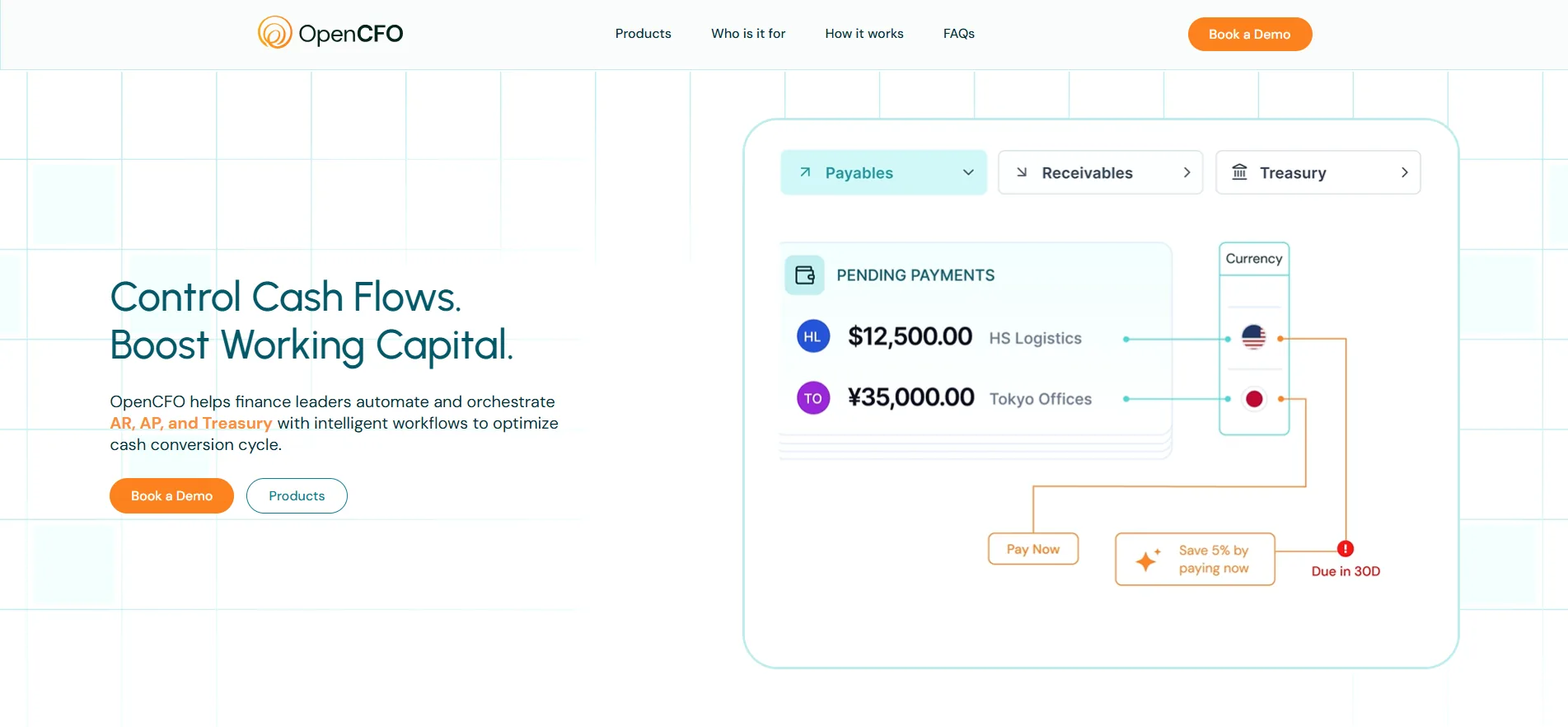
opencfo.ai
OpenCFO — Main View

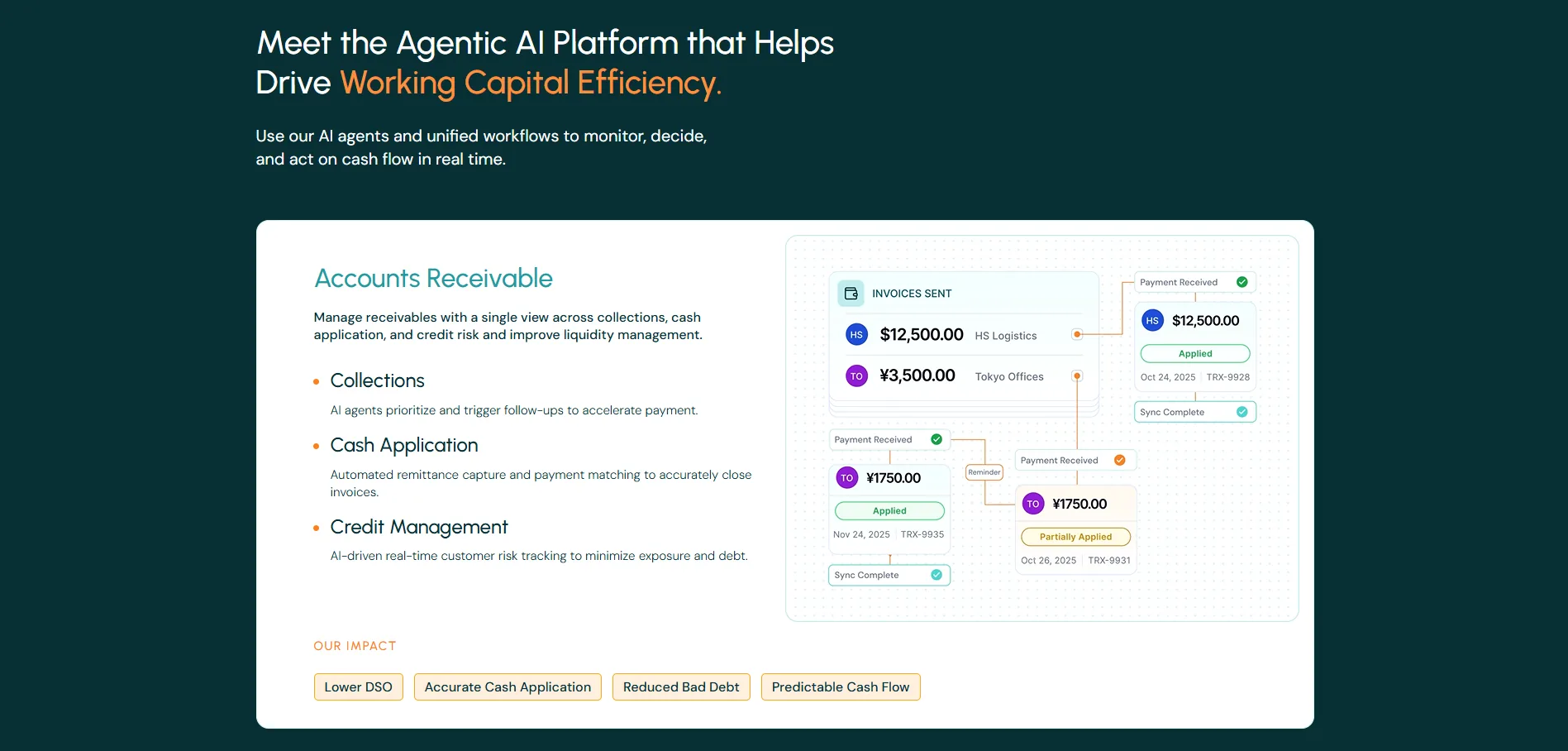
OpenCFO — Cash Flow Intelligence Dashboard

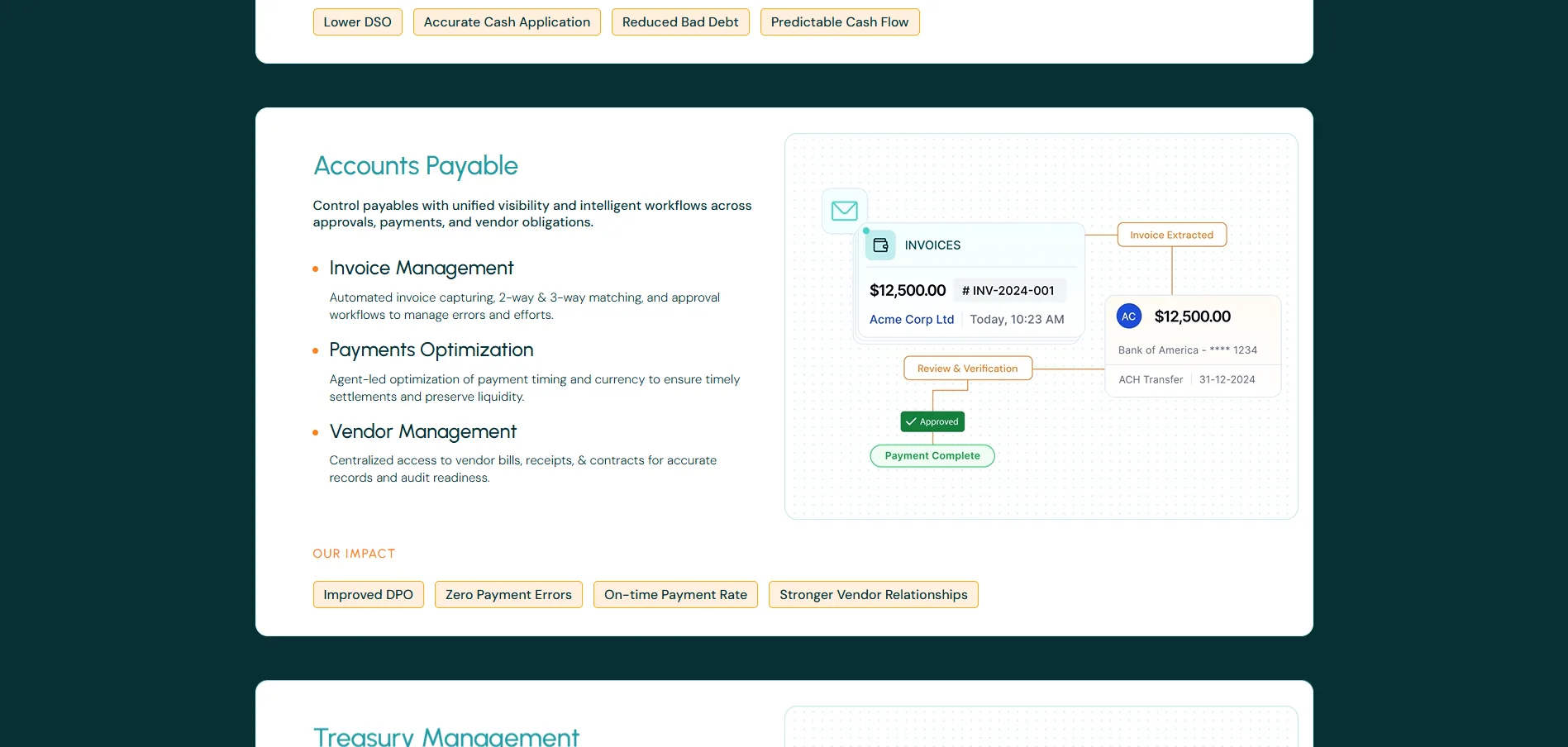
OpenCFO — Screen 2
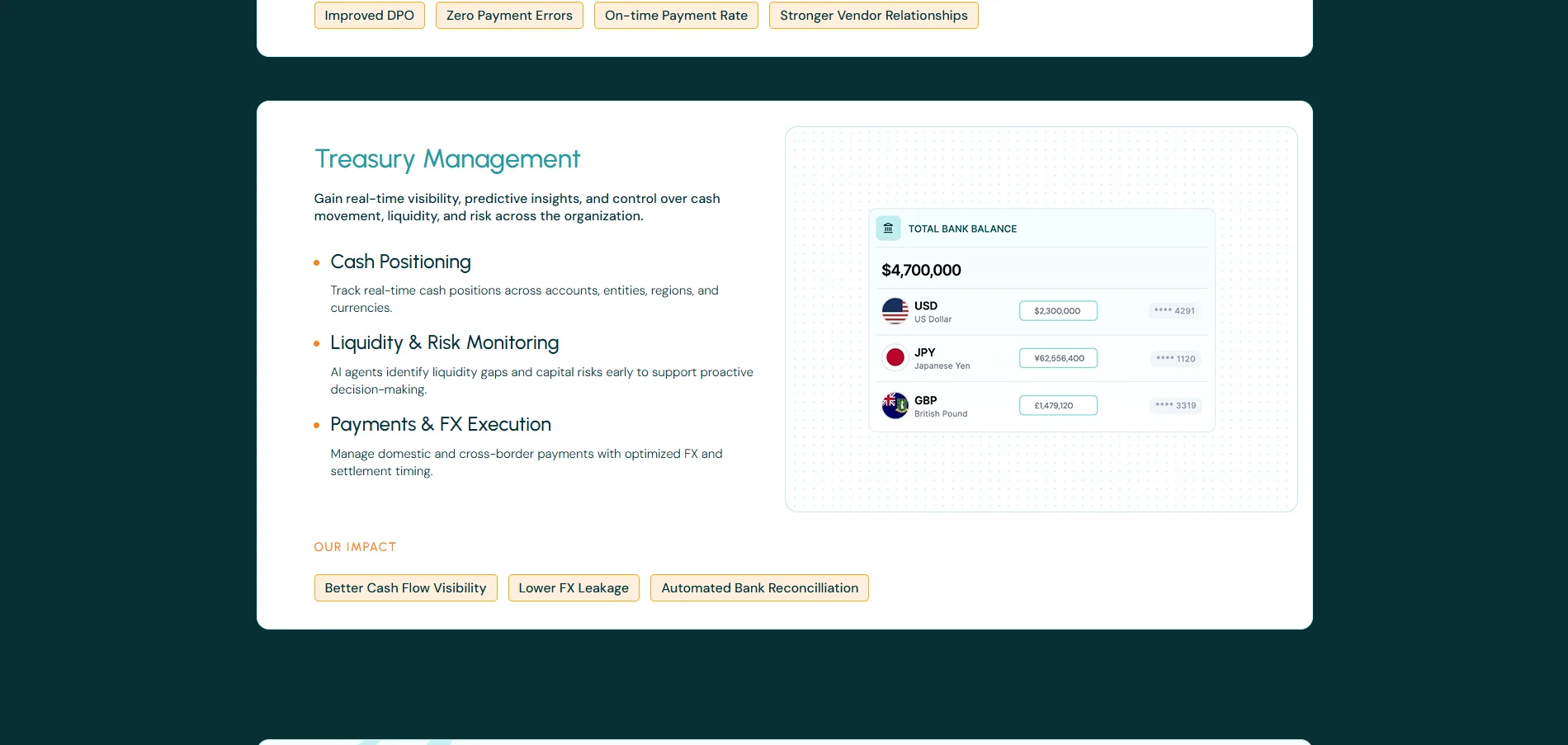
OpenCFO — Screen 3
OpenCFO — Screen 4
Design Decisions

Built for the
CFO's mindset

Unified Cash Flow Dashboard

Real-time position visualization across all connected accounts. One source of truth, always current.

AI-Powered Forecasting

Scenario modeling with 98% accuracy — best case, base case, stress test — driven by actual transaction patterns.

Intelligent Anomaly Alerts

AI surfaces unusual patterns before they become crises — working capital optimization built into the notification layer.

Progressive Disclosure

Complex financial data revealed in layers — summary first, drill-down on demand. Data-dense but never cluttered.

Design System

Financial-grade
component library

Color Tokens
--accent #F59E0B
--accent-secondary #D97706
--bg #090701
--bg2 #0e0c03
--negative #f87171
Components
Primary Action Ghost Variant Status Cleared Status Pending AI Forecast
Typography Scale
48px Display Heading
32px Section Title
14px Body — Financial data narrative text
11px DATA LABEL / CAPTION

Measured Outcomes

Design that
moved the needle

Every design decision was validated against real CFO workflows. The results speak to the power of truly user-centered financial design.

0
Cash Visibility Speed

Improvement in time to see full cash position across all accounts.

0
Time to First Insight

Average time from account connection to actionable cash flow insight.

0
Forecast Accuracy

AI prediction accuracy rate validated against actual transaction outcomes.

0
Manual Reconciliation

Reduction in hours spent on manual spreadsheet reconciliation work.


"OpenCFO required the rarest UX balance: making complex financial data feel intuitive without dumbing it down. The breakthrough was designing around the CFO's actual mental model — not the database schema."

Rupesh Chavan — Product & UI/UX Designer