Bringing Intelligence to Enterprise Data Governance
Redesigning OpenMetadata's platform UX and marketing website — making enterprise-grade data discovery,
lineage, and governance feel as intuitive as a consumer product.
Data DiscoveryData LineageData Governance500+ IntegrationsISO 27001 Compliant50K+ Active UsersSemantic SearchRole-Based AccessEnterprise Open SourceData DiscoveryData LineageData Governance500+ IntegrationsISO 27001 Compliant50K+ Active UsersSemantic SearchRole-Based AccessEnterprise Open Source
0Active Users
0Native Integrations
0Search Speed Increase
ISO 27001Security Compliant
The Challenge
OpenMetadata is one of the world's most comprehensive open-source data catalog and metadata management
platforms. Despite its powerful backend, the user experience needed a complete rethink — one that would
serve both the data engineer writing SQL at 2am and the CDO presenting data governance posture to a board.
My scope covered the full product experience: the core application UX, the information architecture for
200+ entity types, and the marketing website that had to translate deeply technical capabilities into
business value for enterprise buyers.
My Contribution
Product StrategyInformation ArchitectureUI System DesignData VisualizationNavigation DesignMarketing WebsiteComponent LibraryUser Research
Sole designer responsible for both the product and the marketing site. Worked directly with the founding
engineering team, research from enterprise design partners, and conducted usability testing across data
engineer, analyst, and data governance personas.
Research & Problem
Data teams were flying blind
Enterprise data teams had no unified view of their data landscape. Metadata was scattered across warehouses, BI
tools, and pipelines. Data engineers spent 40% of their working time just finding and understanding data — not
analyzing it. The real problem was invisible infrastructure.
01 — Discovery
The Data Discovery Problem
Data engineers spent an average of 2.5 hours per day searching
for the right dataset. Discovery was tribal knowledge, not systematic — the "right" dataset lived in
someone's head, not in any tool. New hires took months to reach full productivity.
02 — Trust
Trust and Lineage
Without data lineage visualization, teams couldn't trust data freshness or understand upstream/downstream
dependencies. A single schema change in a source database would silently break 12 dashboards. There was no
way to see the blast radius before making changes.
03 — Governance
Governance Complexity
Data governance tools were either too technical (CLI-only, no visualisation) or too simplified (no depth for
power users). Enterprise teams needed both: the power of a developer tool and the accessibility of a
business application — in the same interface.
02 — User Research
User Persona & Goals
Three enterprise data personas with distinct responsibilities,
workflows, and pain points — each requiring the platform to speak a different language while staying within
the same interface.
👤
Shreya Bhat
Data Engineer, 31
Goals
Discover datasets quickly without tribal knowledge
Track data lineage across upstream and downstream
Set up automated data quality checks
Pain Points
No central catalog — discovery depends on who you know
Hours spent searching for the right table
🧑
Kiran Nair
Data Scientist, 38
Goals
Understand data context before modelling
Find trusted, certified datasets reliably
Track experiment metadata across projects
Pain Points
Stale documentation makes context untrustworthy
Unclear data ownership leads to repeated work
👩
Priya Iyer
Data Governance Lead, 44
Goals
Enforce data policies across the organisation
Track compliance with regulatory requirements
Understand how data is being used enterprise-wide
Pain Points
Manual governance spreadsheets don't scale
No audit trail for data access or usage
03 — Business Challenges
Core Challenges
CHALLENGE 01
🔍
Data Discovery at Scale
With thousands of tables, pipelines, and dashboards, finding the right
dataset without a catalog meant relying on tribal knowledge — slow, inconsistent, and impossible to
onboard against.
CHALLENGE 02
🛡️
Trust and Data Quality Signals
Data teams needed visible signals of data freshness, ownership, and
certification — without those signals, every dataset required manual verification before it could be
trusted in analysis.
CHALLENGE 03
⚖️
Governance Without Bureaucracy
Traditional governance tools added friction that teams resisted. OpenMetadata
needed to embed governance naturally into the discovery workflow — making compliance the path of least
resistance.
CHALLENGE 04
🔄
Metadata Freshness
Stale documentation and outdated metadata was often worse than no
documentation — it created false confidence. Automated, always-current metadata was a technical and UX
requirement.
04 — Secondary Research
Market Insights
FINDING 01
40%
Data Engineer Time Spent Searching
Data engineers spend 40% of their working time searching for and understanding
data — time that should be spent on analysis, modelling, and building pipelines.
FINDING 02
63%
Analytics Projects Delayed by Discovery
63% of analytics and data science projects experience delays caused by data
discovery bottlenecks — a systemic problem that better tooling directly addresses.
FINDING 03
3×
Faster Onboarding with Data Catalogs
Organisations with active data catalogs onboard new data professionals 3× faster
— making the catalog a strategic talent and productivity investment, not just a governance tool.
05 — User Stories
What Users Need
As a...
I want to...
So that...
Priority
Data Engineer
Search for datasets by name, tag, or description instantly
I stop spending hours asking colleagues which table to use
High
Data Scientist
See data lineage and ownership on every dataset
I can trust the data before investing modelling time
High
Governance Lead
Define and enforce data policies across all assets
Compliance is automated rather than manually audited
High
Data Consumer
See freshness indicators and quality scores inline
I know whether the data is safe to use before I query it
Medium
Data Owner
Receive alerts when my datasets are accessed or modified
I maintain visibility and accountability for my data assets
Medium
06 — Competitor Analysis
Market Landscape
Feature
Alation
Collibra
Atlan
DataHub
OpenMetadata
Auto-discovery
✓
~
✓
✓
✓
Data Lineage
✓
✓
✓
✓
✓
Quality Checks
~
~
✓
✕
✓
Collaboration
✓
✓
✓
~
✓
API-first
~
✕
~
✓
✓
Open Source
✕
✕
✕
✓
✓
Data Glossary
✓
✓
✓
~
✓
07 — User Flow
The Journey
01
Connect Data Source
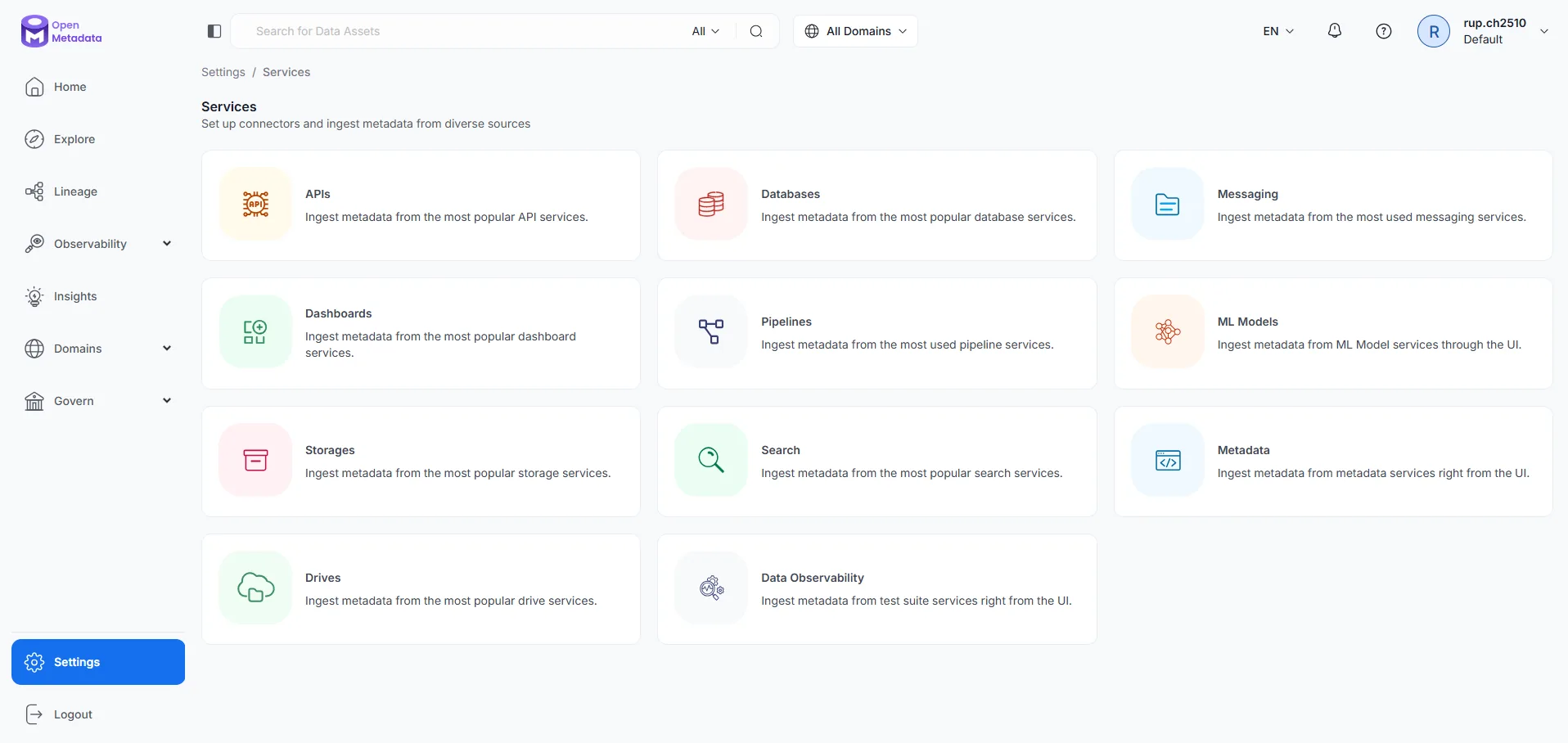
Connect warehouses, BI tools, and pipelines via 500+ native integrations
with zero-code setup
02
Auto-discover Assets
AI automatically scans and indexes all data assets, building the catalog
without manual entry
03
Enrich Metadata
Teams add descriptions, tags, ownership, and quality rules to enrich
auto-discovered assets
04
Search & Explore
Users search the catalog with semantic queries, filters, and type-ahead to
find trusted data in seconds
05
Track Lineage
Visual lineage graph shows upstream sources and downstream consumers for
every asset
06
Govern Policies
Governance leads define, apply, and audit data policies across the entire
estate from a single dashboard
08 — Toolkits
Tools & Workflow
Tools and methods used throughout the design process — from enterprise
user research through information architecture, interaction design, and final delivery.
🎨FigmaUI Design
🗂️FigJamWorkshops
📋NotionDocumentation
🗺️MiroJourney Mapping
🧪MazeUsability Testing
Design Process
From chaos to catalog
A six-phase process that started with enterprise user research and ended with a cohesive design system deployed
across both the product and the marketing website.
01
Enterprise User Research
Interviews with data engineers, analysts, and CDOs across 15+ enterprises. Journey
mapping, pain-point taxonomy, persona definition.
02
Information Architecture
Designed the IA for 200+ entity types — tables, pipelines, dashboards, ML models,
topics, containers. Hierarchical taxonomy and relationship mapping.
03
Navigation System
Rebuilt the global navigation to support role-based contexts. Data engineers,
analysts, and governance officers each needed a different primary path.
04
Search & Discovery UX
Semantic search with faceted filtering, type-ahead, relevance signals, and
intelligent ranking. Reduced discovery time from 2.5 hrs to under 20 minutes.
Designed open-metadata.org to convert enterprise buyers — clear value props,
integration directory, pricing clarity, documentation entry points.
Final Design
The Platform
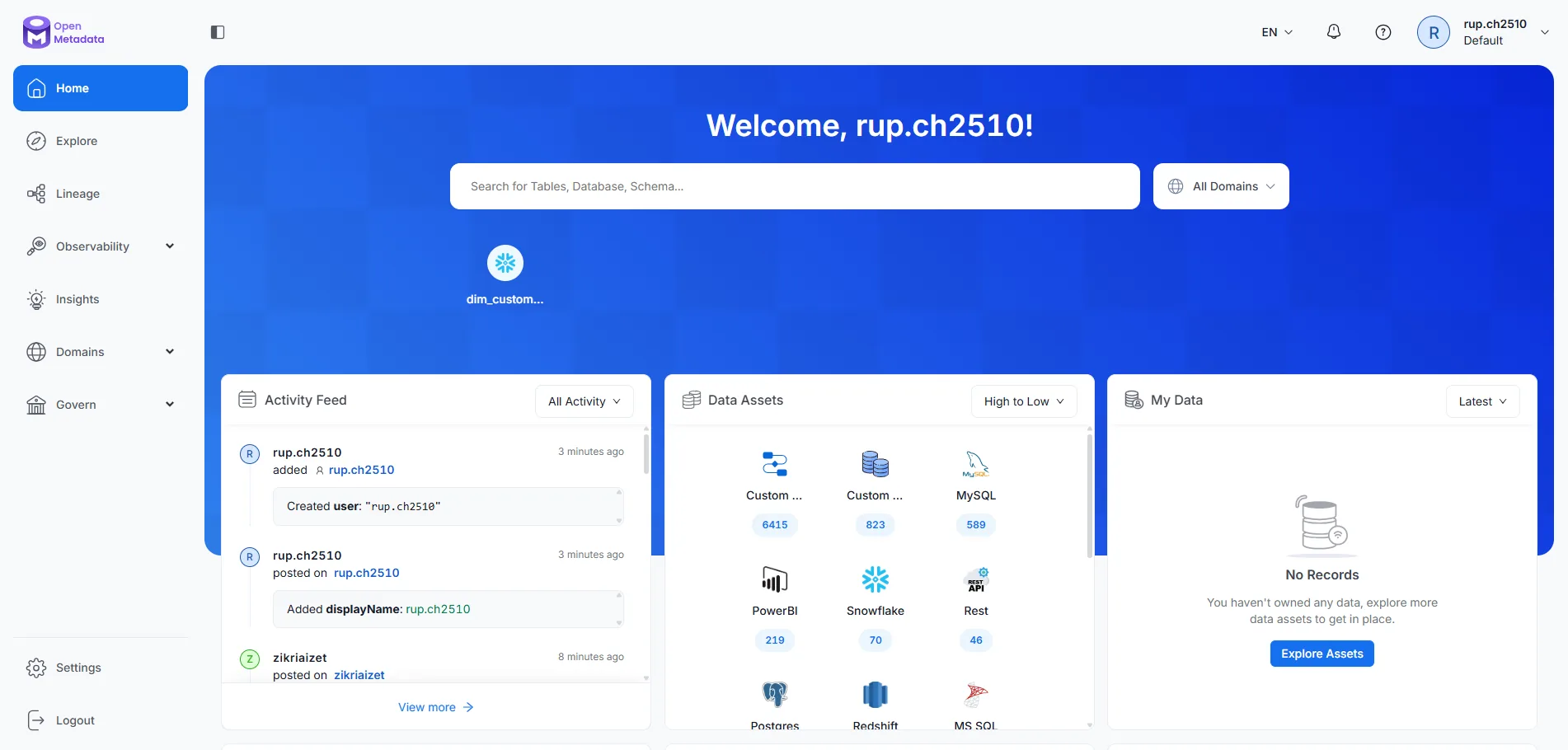
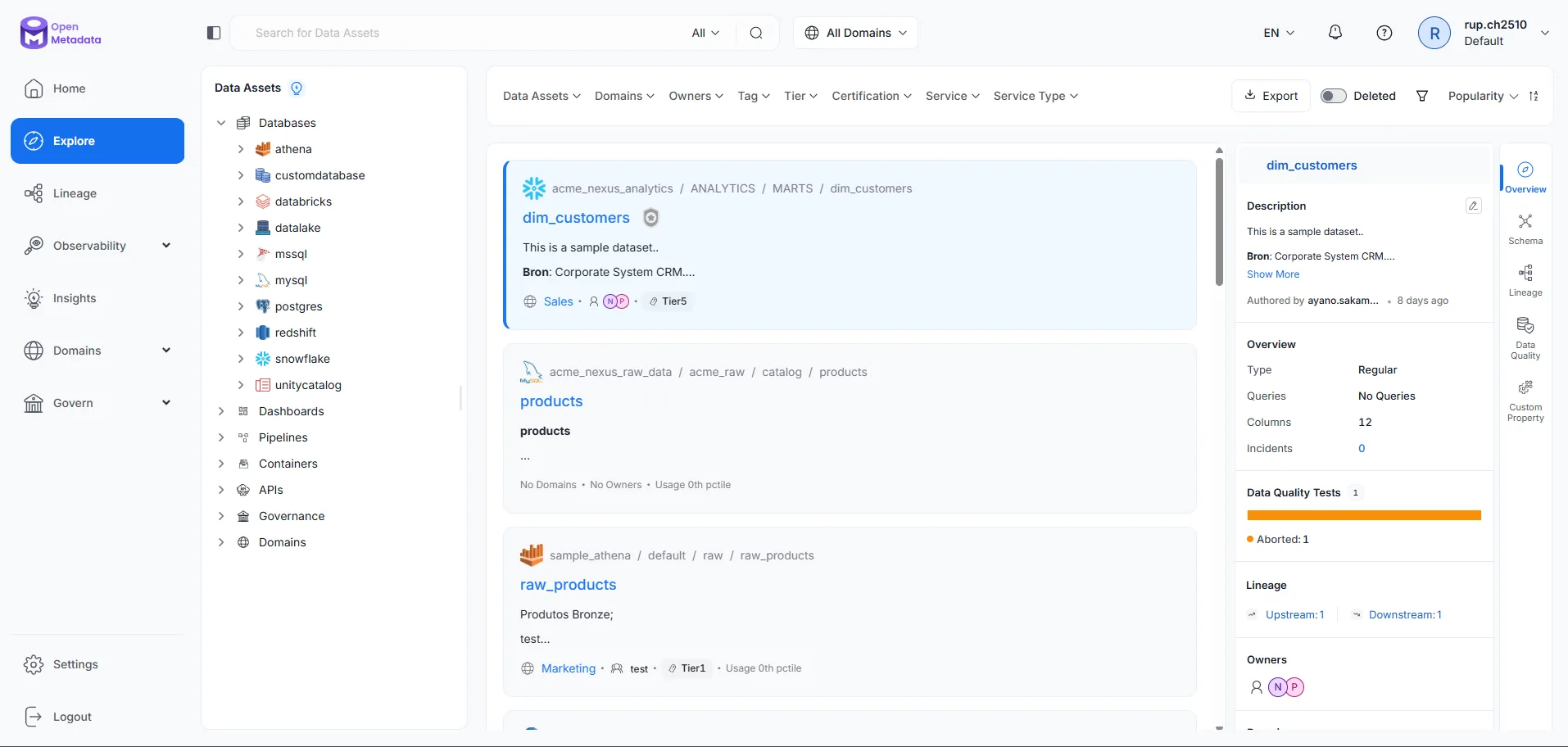
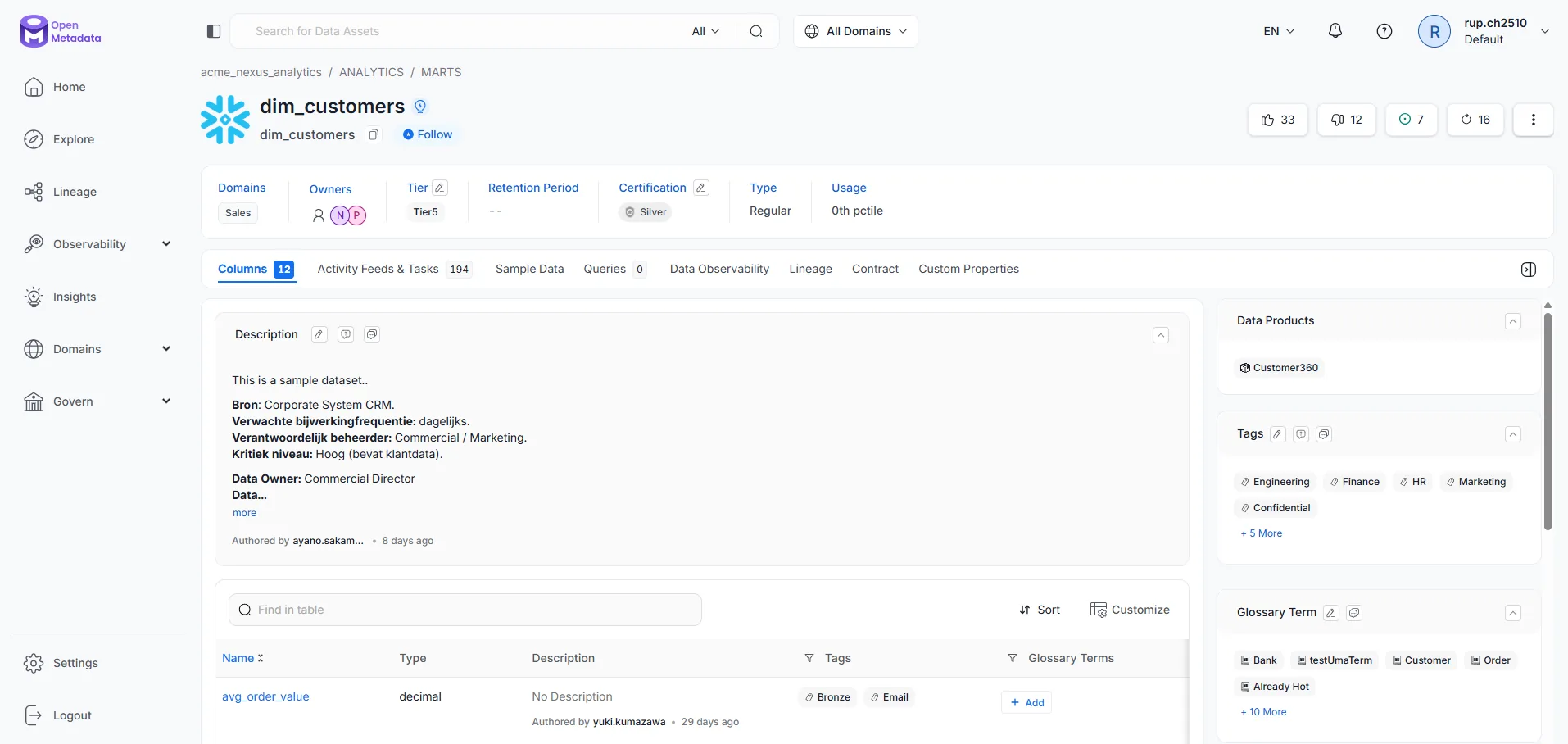
A unified data catalog with intelligent search, interactive lineage visualization, and role-based navigation.
Every interaction designed around how data professionals actually think — not how data is stored.
sandbox.open-metadata.org
OpenMetadata — Data Catalog Explore View
Design Highlights
Five systems, one experience
Unified Catalog with Semantic Search
Intelligent semantic search across all entity types with faceted filters,
relevance scoring, and contextual previews. Reduced mean discovery time from 2.5 hours to under 20 minutes
in usability testing.
Interactive Data Lineage Graph
Node/edge visualization of full upstream and downstream dependencies.
Collapse/expand subtrees, highlight impact paths, and see freshness status inline — all without leaving
the catalog record.
Role-Based Personalised Dashboard
Engineers, analysts, and governance officers each land in a personalised view of
their data landscape — surfacing the entities, pipelines, and quality signals most relevant to their role
and team.
Marketing Website
Designed open-metadata.org to convert enterprise buyers — visual integration
directory, clear platform value hierarchy, enterprise proof points, and a documentation onboarding funnel
that reduced time-to-first-value.
Documentation-Integrated In-App Help
Contextual help panels, inline tooltips, and deep-linked documentation that appear
at the exact moment of need — without forcing users to leave the application. Built as a design system
component so engineering could wire it to any entity type.
Design System
Built for enterprise scale
A comprehensive component library and design token system built specifically for enterprise data UI — covering
data visualization, entity cards, lineage components, form patterns, and status indicators.
Monthly active users across enterprise and open-source deployments
0
Faster Discovery
3x improvement in data discovery speed post-redesign, measured by user sessions
0
Integrations
Native integrations with data warehouses, BI tools, pipelines, and ML platforms
0
Fewer Support Tickets
Reduction in data-related support tickets, attributed to improved
discoverability
“
OpenMetadata was a masterclass in designing for complexity without losing clarity. The challenge: making
enterprise-grade data management feel accessible to data scientists without losing the depth that senior data
engineers needed. Information architecture was everything.