Security You Can Feel
in Every Interaction
A multichain crypto wallet designed to make digital asset management feel as trustworthy as a bank vault, intuitive for beginners, powerful for veterans.

A multichain crypto wallet designed to make digital asset management feel as trustworthy as a bank vault, intuitive for beginners, powerful for veterans.
Crypto wallets existed on a broken spectrum. At one end: maximally complex interfaces built for power users, where security features were buried inside convoluted menus that demanded deep technical literacy. At the other: dangerously simplified apps that stripped out security signals entirely, leaving beginners unable to evaluate the risks of what they were doing.
Neither group was well-served. The result was an industry-wide trust gap. New users stayed out of crypto entirely, while experienced users built brittle workarounds to manage complexity.
The answer wasn't to pick a side, it was to design a system that could serve both simultaneously. A progressive disclosure model: simple and reassuring by default, with the full power of a professional-grade tool available the moment the user needs it.
Sahal Wallet's mission was to make security feel like a feature, not a friction point. In crypto, trust is the product. Every screen had to communicate: "you are in control, you are safe, and we will never let you make an invisible mistake."
Research Insights
| Feature | MetaMask | Trust Wallet | Coinbase Wallet | Sahal |
|---|---|---|---|---|
| Multi-chain Support | ~ | ✓ | ~ | ✓ |
| Simple Onboarding | ✕ | ~ | ✓ | ✓ |
| Biometric Security | ~ | ✓ | ✓ | ✓ |
| NFT Gallery | ~ | ✓ | ✓ | ✓ |
| DeFi Integration | ✓ | ~ | ~ | ✓ |
| Gas Fee Transparency | ~ | ✕ | ~ | ✓ |
Crypto wallets sit at the intersection of maximum financial consequence and minimum user expertise. Every design decision had to answer the same question: does this make users more confident or more anxious?
Every screen answers one question before the user can ask it: "Is this safe?" The portfolio view unifies 12 blockchains into a single confident number. The transaction confirmation screen shows exactly what will happen, and what it costs, before you commit.
Design Highlights
Sahal Wallet, Digital Finance Interface
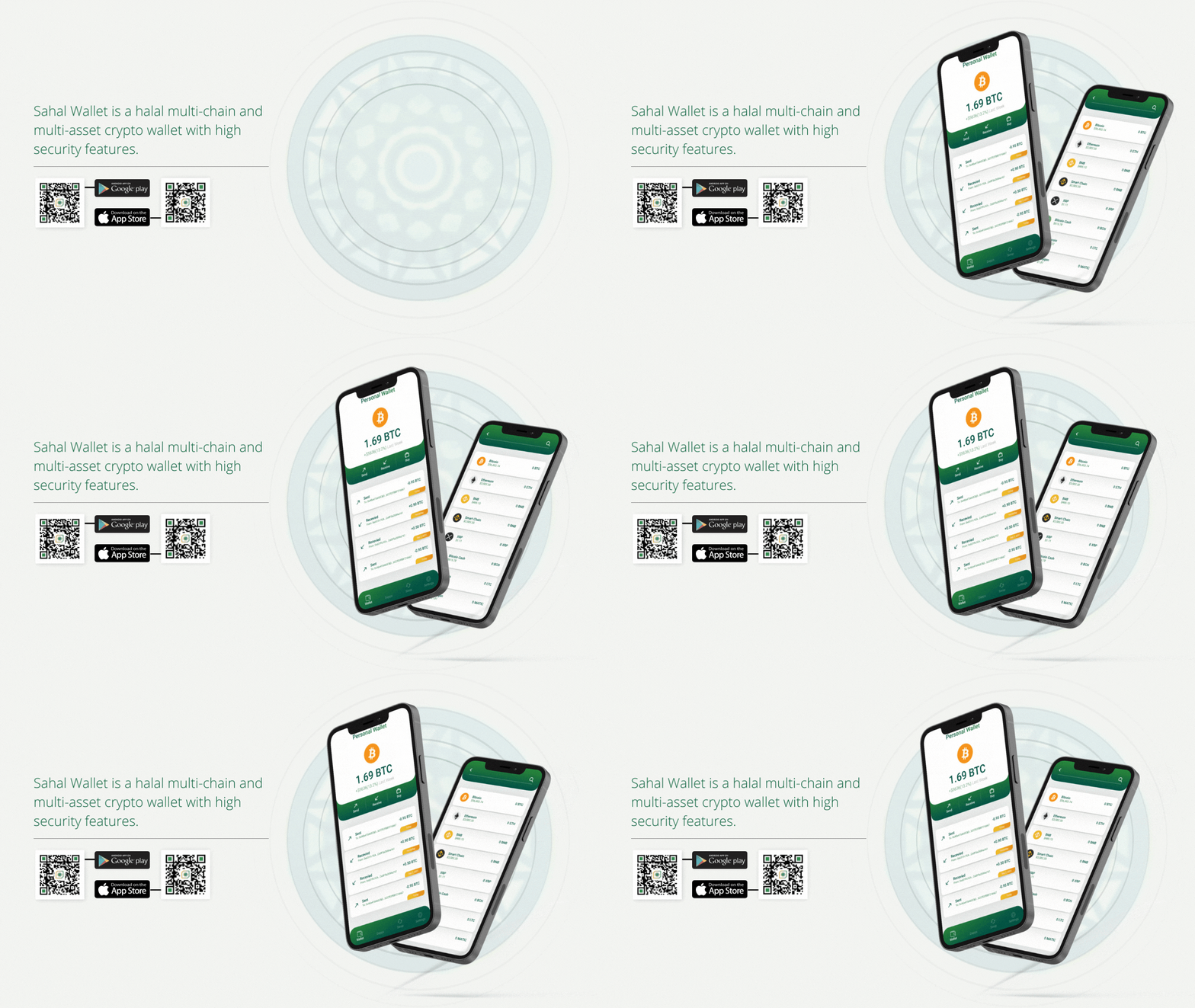
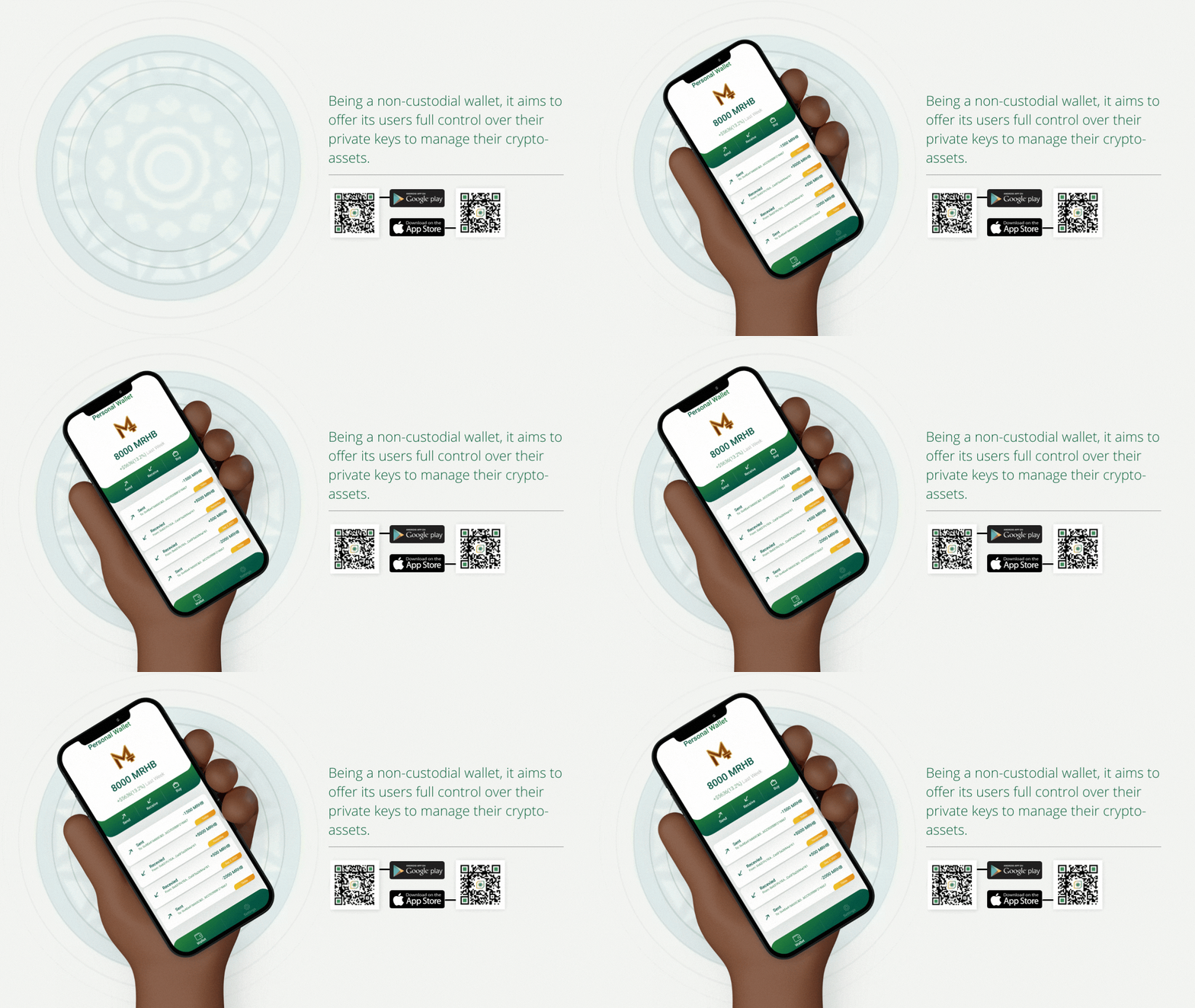
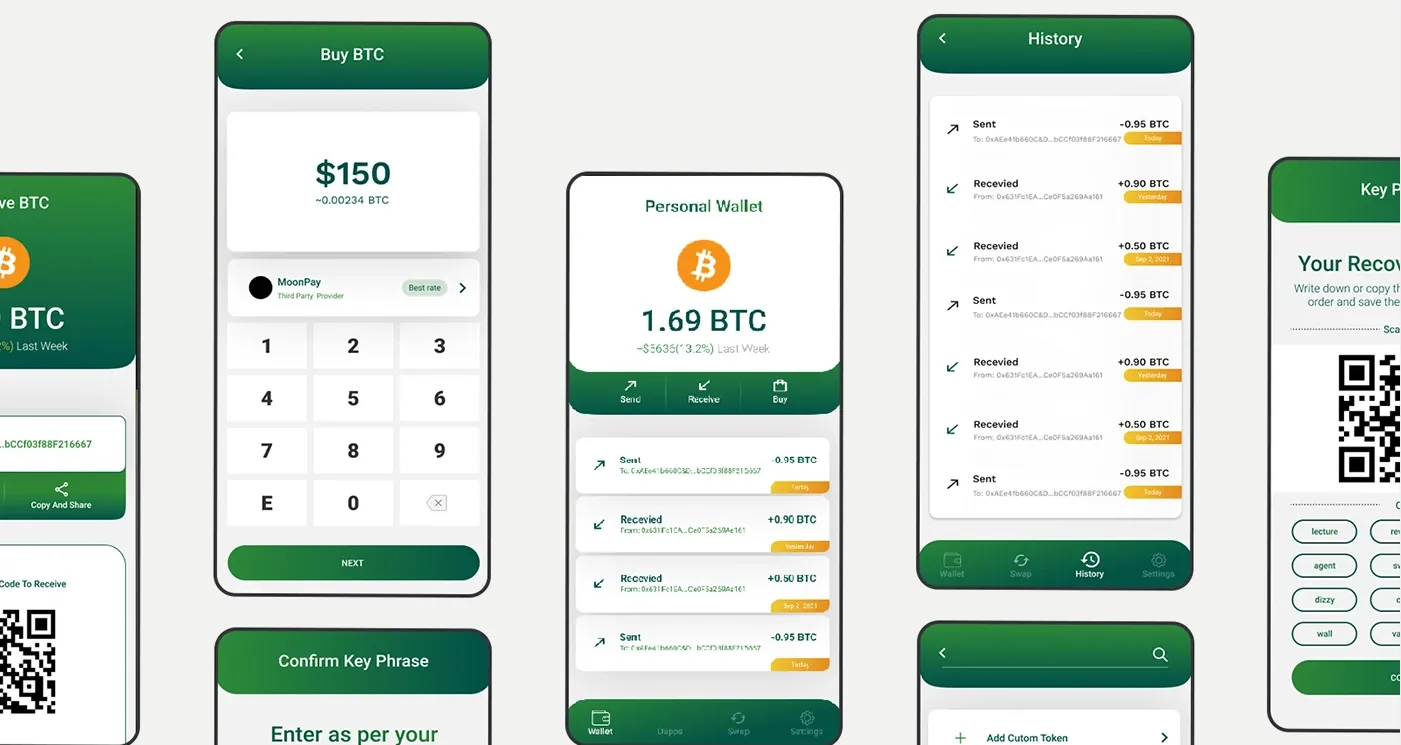
Every design token in Sahal Wallet was chosen to communicate one message: this is a financial instrument worthy of your most valuable assets. Dark luxury meets blockchain-native precision.
Green communicates growth and trust, the color of nature, of progress. Deep forest tones ground the interface with premium weight. Financial green and red are preserved from global convention: gain stays green, loss stays red, universal signals users already know.
Financial values use tabular-nums Space Grotesk for pixel-perfect alignment. Labels are always uppercase with tight tracking. A visual signal borrowed from trading terminal aesthetics.
All 12 chains share the same component vocabulary. Chain identity is expressed through colored icons and subtle accents, never through divergent layout patterns.
The design outcomes for Sahal Wallet validated a core hypothesis: that making security visible, legible, and confidence-building directly reduces transaction errors and drives adoption among previously excluded user segments.
"The seed phrase screen is where most crypto wallet UX fails. We tested five different approaches. All-at-once display, word-by-word reveal, grouped sets of four, confirmation quizzes, visual mnemonics. The one that worked best wasn't the most novel. It was the one that treated the user like an intelligent adult who understands the stakes, gives them everything they need in one clear view, and then confirms understanding without making them feel tested. The difference between making someone feel safe and making someone feel surveilled is smaller than most designers appreciate."
"The best security UX is the kind that builds confidence while doing its job invisibly. If a user feels safe, the security is working. If they feel anxious, the design has failed, regardless of how solid the underlying system is."