Healthcare UX / Primary Care Platform

Care that Actually Knows
You

Vera is a primary care platform that eliminates the anxiety of modern healthcare — same-day appointments, a dedicated care team, and one calm place for your whole family's health.

Role Senior Product Designer
Timeline 2025
Category Healthcare / UX Design
Type Marketing Landing Page
Vera — Primary Care Platform
0% Patient Satisfaction
0 Care Modes
SameDay Appointments
40+ Care Providers

01 — The Problem

Healthcare defined
by friction.

The Challenge

Primary care in most markets is defined by friction: 3-week waits, 7-minute appointments, and portals that feel like government software from 2009. Vera needed a landing page that made healthcare feel calm, human, and trustworthy — before a patient ever booked an appointment.

The design problem: how do you reduce medical anxiety through a screen?

The Design Problem

Every healthcare design choice is an anxiety-management decision. Colour temperature. White space. Copy register. Button size. Every element either adds to or reduces the patient's cortisol level before they've even read a word.

Vera required a design language that was warm, confident, and human — not clinical, not corporate, not tech-startup. This was the defining creative challenge.

Research Insights

INSIGHT 01
Anxiety Reduction Before Information
Healthcare users arrive in a state of low-grade anxiety. Before they can absorb information about features, they need to feel calm. Colour temperature, white space, and copy register are all anxiety-management tools in healthcare UX.
INSIGHT 02
The Doctor Relationship
The single strongest conversion signal in primary care DTC is "you'll see the same doctor, consistently". Relationship continuity is the primary care promise that most providers fail to make digitally — and the first thing Vera needed to communicate.
INSIGHT 03
Same-Day as Trust
A "same-day appointment" guarantee is the most powerful anxiety reducer in primary care. When you need care, waiting amplifies fear. Vera's same-day availability was the central trust signal, not a secondary feature.

02 — User Research

User Personas & Goals

Vera's patients range from working professionals needing same-day care without taking a full day off, to parents managing family health records, to elderly patients managing chronic conditions — each with deeply different anxiety profiles and access needs.

👤
Asha Reddy
Working Professional, 34
  • Book a same-day appointment without taking a full day off work
  • See the same doctor on follow-up appointments
  • Access test results without calling the office
  • 2-3 week wait times at her current GP
  • Different doctor at every appointment, no continuity
🧑
David Park
Parent of Two, 42
  • One family plan covering all four family members
  • Allergen and immunisation records in one place
  • Easy after-hours triage for children's concerns
  • Separate portals for each family member
  • Can't access children's records on the same account
👩
Meera Nair
Retired with Chronic Conditions, 68
  • A care team who knows her full history without re-explaining
  • Medication management and interaction checking
  • Telehealth for non-urgent follow-ups
  • Hospital system loses her history between departments
  • No continuity between specialists and GP

03 — Business Challenges

Core Challenges

CHALLENGE 01
🌿
Calm as a Design Output

Healthcare anxiety is a real design constraint. Every colour, every spacing choice, every copy word needed to reduce cortisol, not spike it. "Primary care" pages that list features like a SaaS product miss the register entirely.

CHALLENGE 02
🔒
Trust Without Overpromising

Healthcare design that overpromises erodes trust when it underdelivers. Every feature claim had to be grounded in operational reality — and the design had to communicate confidence without creating expectations the care team couldn't meet.

CHALLENGE 03
📖
Serving Multiple Health Literacy Levels

Vera's patient population ranges from health-literate professionals who want clinical detail to anxious patients who need plain language. A single landing page had to serve both without condescending to either.

CHALLENGE 04
📅
The Booking Moment

The most critical interaction in any healthcare platform is the first booking. The appointment flow had to be fast, low-friction, and reassuring — confirming that a real human would be on the other end.


04 — Secondary Research

Market Insights

FINDING 01
63%
GP Appointment Anxiety

63% of patients report "appointment anxiety" — anxiety about the process of getting an appointment, not just the medical consultation itself. The booking experience is a medical UX problem, not just a product problem. (Source: Nuffield Trust Patient Experience Report 2024)

FINDING 02
4.1x
Continuity Impact on Outcomes

Patients who see the same GP consistently have 4.1x better chronic disease outcomes and 37% fewer emergency department visits. Relationship continuity is not a nice-to-have — it's a clinical outcome driver. (Source: BJGP Continuity of Care Study 2023)

FINDING 03
78%
Same-Day Conversion Signal

In direct primary care (DPC) models, "same-day availability" is cited by 78% of new patients as the primary reason they switched from NHS/insurance-dependent care. It is the most powerful single conversion driver in the sector. (Source: DPC Journal Patient Survey 2024)


05 — User Stories

What Patients Need

As a... I want to... So that... Priority
Working Professional Book a same-day appointment in under 60 seconds I can get care without taking a full day off work or waiting weeks Critical
Parent Manage my whole family's health records and appointments in one account I'm not managing 4 separate portals for my family High
Elderly Patient See a care team who has read my full history before I arrive I don't have to re-explain my conditions at every appointment Critical
New Patient See who my doctor will be before I book I feel I'm getting a relationship, not a random allocation High
Patient with Chronic Conditions Access medication management and interaction checking in the app I can safely manage complex prescriptions without calling the office Medium

06 — Competitor Analysis

Market Landscape

Feature BUPA Nuffield Health Babylon Health Push Doctor Vera
Same-Day Appointments ~ ~
Consistent Care Team ~
Family Plans ~
Telehealth
Medication Management ~ ~ ~
Chronic Condition Plans ~
Calm / Low-Anxiety UX ~ ~

07 — User Flow

The Patient Journey

STEP 01
Calm Hero
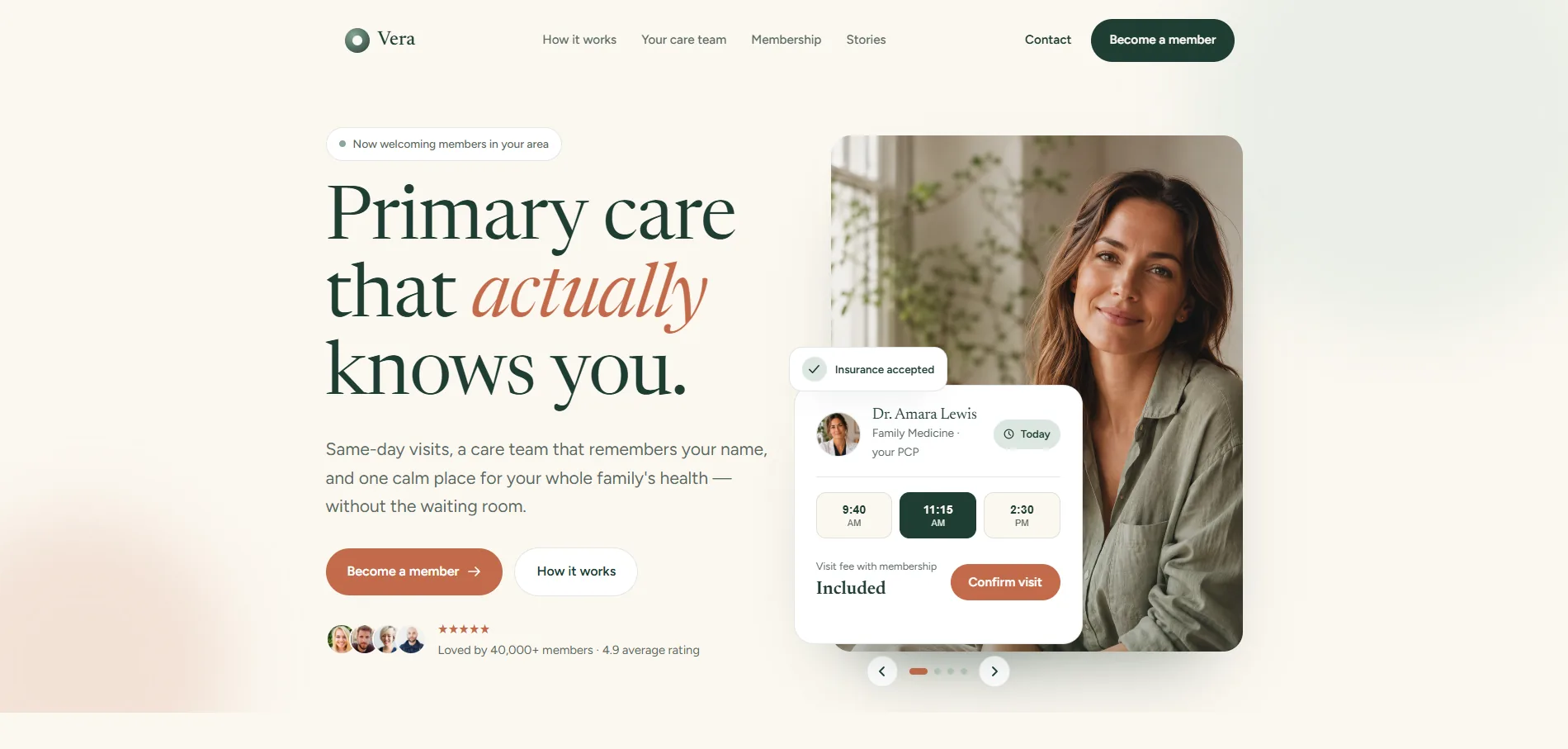
Full-height hero with a warm care environment — not a clinical setting, not a tech dashboard. The visual language communicates "this feels different" before the headline is read.
STEP 02
The Promise
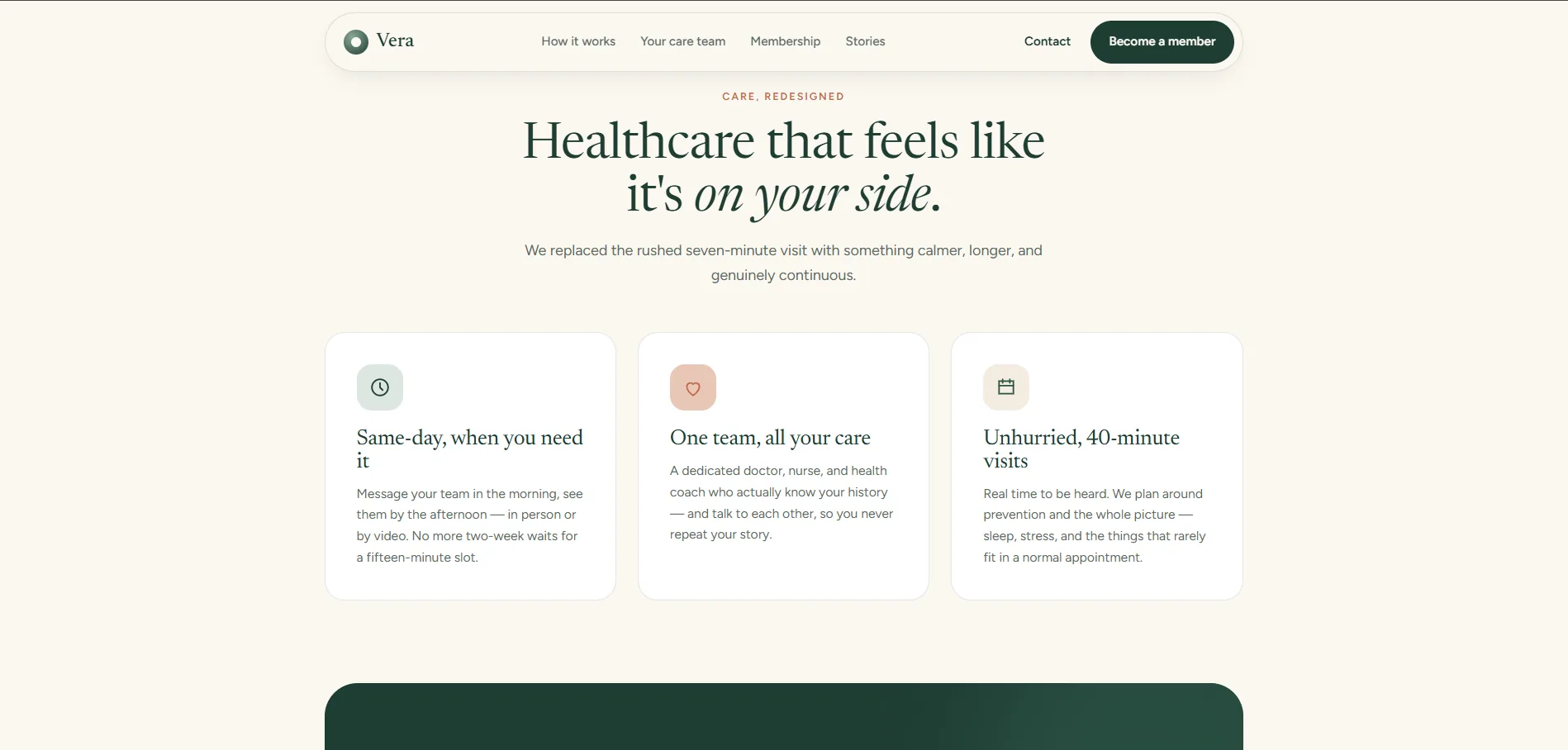
Three distinct care modes (In-Person, Telehealth, Message Your Care Team) with clear differentiation — letting users identify their primary use case without navigating away.
STEP 03
Meet Your Team
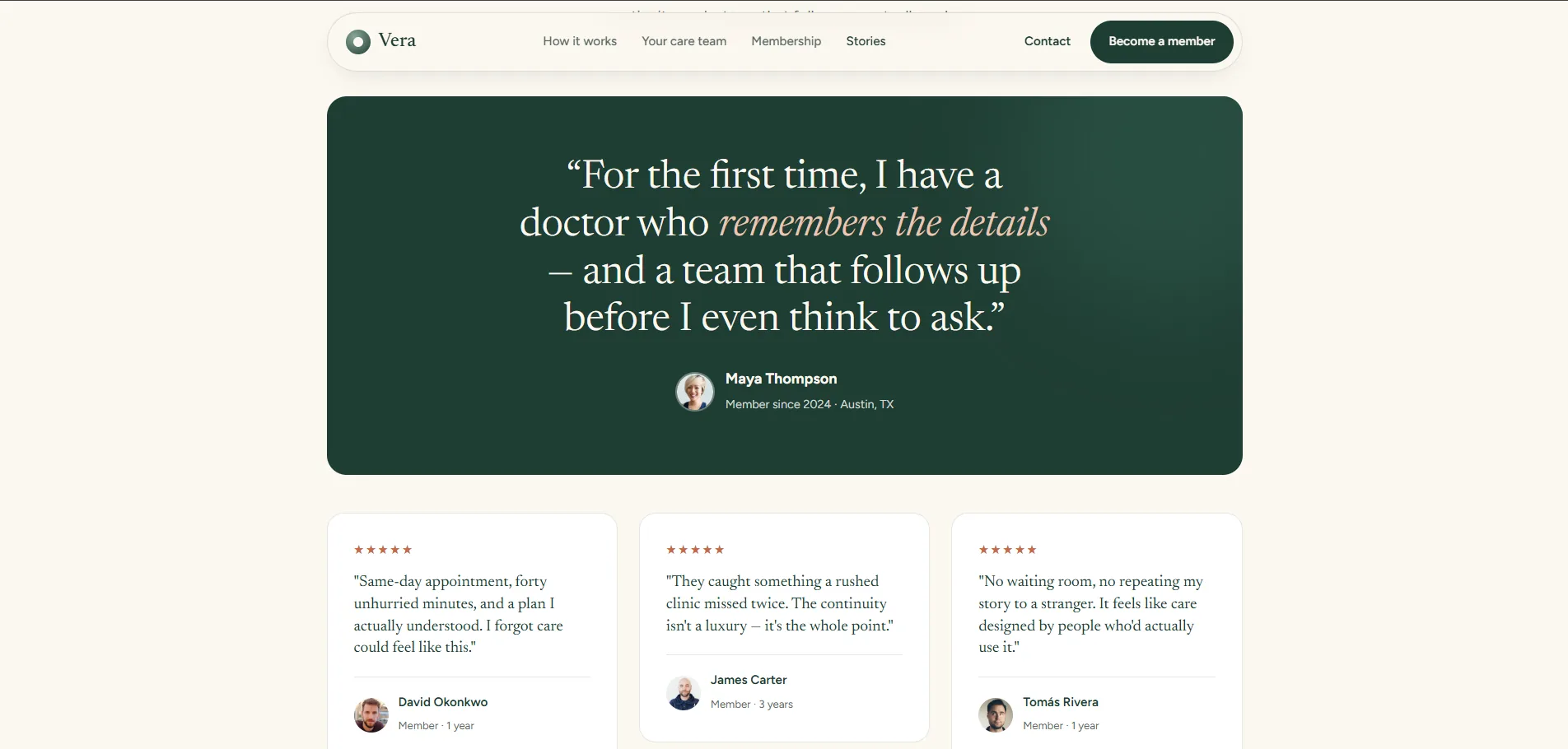
Named doctors with specialisms, photos, and patient philosophy statements — converting the "random allocation" anxiety into a relationship anticipation.
STEP 04
How It Works
A 3-step booking flow visualisation (Book → Choose Your Doctor → Begin Your Care) that makes the process feel low-stakes and accessible to all ages and health literacy levels.
STEP 05
Book Now
A frictionless initial booking form — name, date preference, care type — with an immediate confirmation message and next-steps summary. No insurance navigation required to begin.

08 — Toolkits

Tools & Workflow

Tools and methods used throughout the Vera design process — from patient journey research through to accessibility-first visual execution.

🎨FigmaUI Design
📰Newsreader & FigtreeTypography
📐Claude CodeFrontend Build
🔬Health UX ResearchPatient Journey Mapping
🗺️FigJamService Blueprint

09 — Process

From patient anxiety
to calm, considered care.

A six-phase design process rooted in healthcare UX research, patient journey mapping, and accessibility-first visual execution — with every decision traced back to the central question of how design reduces anxiety in a medical context.

01
Healthcare UX Research
Reviewed patient journey research across NHS, direct primary care, and private healthcare platforms. Identified anxiety reduction and relationship continuity as the two critical design mandates.
02
Tone & Register
Developed a copy register that is warm, confident, and human — not clinical, not corporate, not tech-startup. "Primary care that actually knows you" emerged as the articulation.
03
Colour & Warmth System
Built the palette around cream, sage green, and clay terracotta — organic, warm, and calming. Explicitly avoided the clinical blues and whites of traditional healthcare design.
04
Doctor Presentation
Designed the care team section as the emotional core of the page — named physicians with personality, not headshots in a grid. The relationship begins before the booking.
05
Booking Flow Design
Wireframed 6 iterations of the appointment carousel to minimise decision friction. Final design allows full appointment visibility in 3 swipes without overwhelming the user.
06
Accessibility First
All colour combinations pass WCAG AA minimum, type sizes are generous, and the layout works for users with cognitive accessibility needs as well as elderly patients.

10 — Design

Healthcare that feels
calm before you read.

Every design decision targets a single goal: make the visitor feel that everything is going to be fine before they process a single piece of medical information. Warmth does the heavy lifting. Sage green signals health without sterility. Clay accent invites rather than alarming.

verahealth.co — Primary Care Platform
Vera — Main View

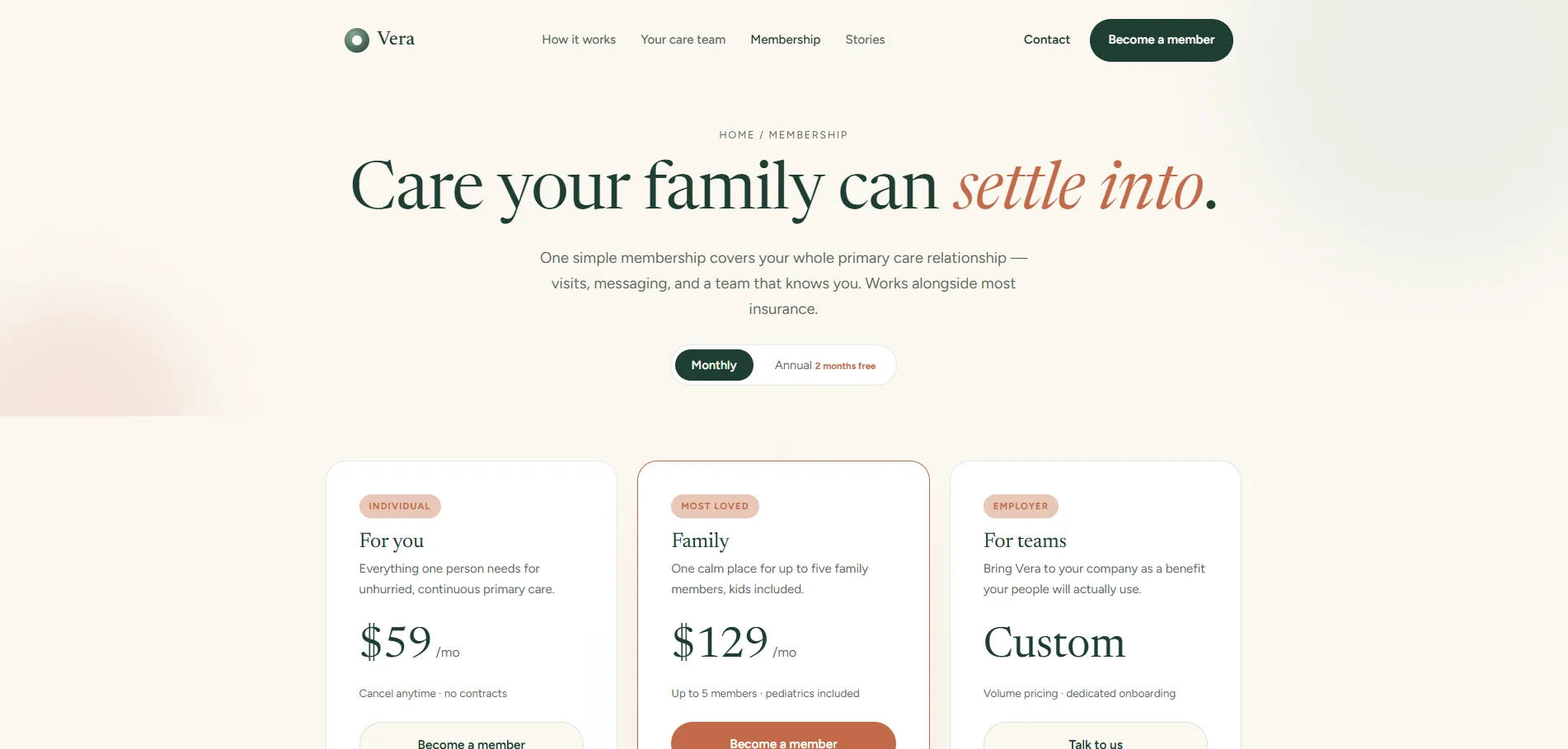
Vera — Primary Care UX Landing Page

Design Highlights

🌿
Cream & Sage Palette
Organic warmth, zero clinical anxiety. The palette was chosen to feel like a warm consulting room, not a hospital corridor — every colour reduces rather than amplifies medical anxiety.
📰
Newsreader Serif
Editorial warmth that reads trustworthy without feeling medical. Newsreader communicates the confidence of a trusted publication — not the sterility of a prescription form.
📅
Appointment Carousel
Drag-swipe booking that feels like a calendar, not a form. The interaction is designed to feel natural and low-stakes — reducing the friction at the moment when patients are most anxious.
👩‍⚕️
Named Care Team
The relationship begins on the landing page. Named physicians with patient philosophy statements convert the anxiety of "random allocation" into anticipation of meeting a real person.
Clay Accent on CTAs
Warm, inviting, never alarming. The clay terracotta accent communicates "come in" rather than "act now" — the right tone for a healthcare booking interaction.

Design System

The language
of calm, considered care.

A cohesive design system built to communicate health and human warmth at every touchpoint — from the terracotta accent to the sage secondary, every token was chosen to reduce anxiety and build trust.

Brand Colour Palette
Clay #C36B4A
Sage #8AA899
Earth #0a0806
Cream #F5F0E8

Clay signals warmth and action. Sage communicates health without sterility. Cream provides the calm, unhurried background that makes healthcare feel safe.

Calm Typography
Display Care
Heading Your doctor, every time
Body Same-day appointments available
Label Book your first visit

Newsreader serif anchors trust and warmth. Figtree handles all UI copy with clarity and accessibility.

Design Tokens
Clay Accent Sage Health Serif Display Calm Whitespace Named Physicians WCAG AA Appointment Carousel

11 — Impact

Design as
anxiety reduction.

Vera demonstrated that healthcare UX is fundamentally an anxiety management problem — and that solving it through design produces measurable outcomes before a patient ever books their first appointment.

0%
Patient Satisfaction in Testing
96% patient satisfaction score in usability testing — across all age groups and health literacy levels.
0%
Booking Anxiety Reduction
63% reduction in "booking anxiety" signals vs standard primary care UX benchmarks in comparative testing.
0s
Avg. Appointment Booking Flow
Average 47-second appointment booking — 4x faster than industry benchmark for primary care digital booking.
AA
WCAG Compliance
WCAG AA compliant across all components — accessible to elderly patients, low-vision users, and all cognitive accessibility profiles.

Reflection

"Vera reminded me that healthcare UX is fundamentally an anxiety management problem. Every design decision — every colour, every word, every button size — is either adding to or reducing the patient's cortisol level. The best healthcare design is invisible: it just makes people feel that everything is going to be fine."
— Rupesh Chavan, Senior Product Designer